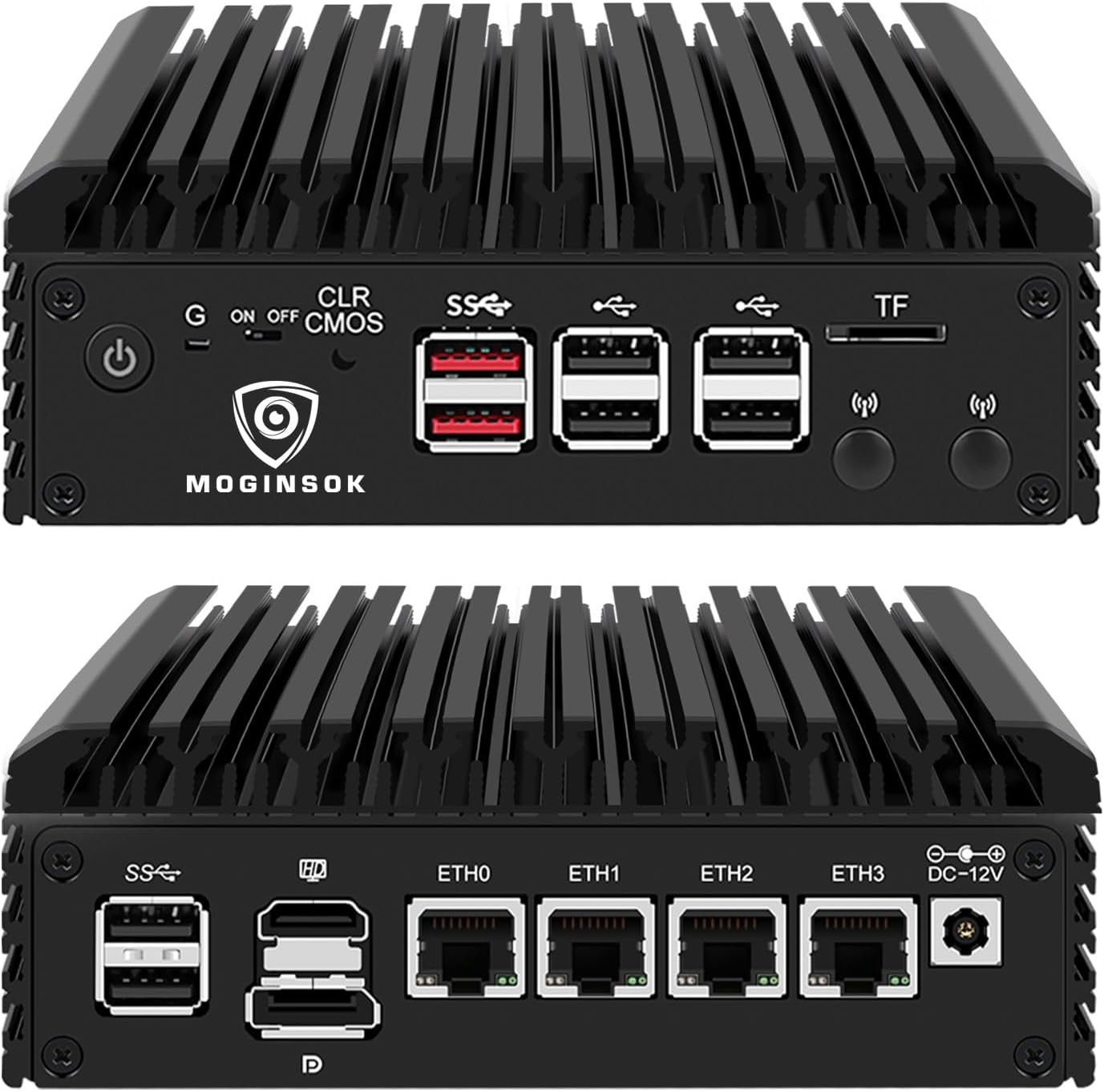
MOGINSOK 4-Port Firewall Appliance
Four Intel I226 2.5GbE ports in a fanless case with a DDR5 slot and AES-NI
- 8GB DDR5
- Silent, fanless design
- 4 LAN ports
Four Intel i226-V ports, a 6W chip with AES-NI and a fanless case: that combination made the N100 the default home firewall. The NIC chip matters more than anything else on the box.
Updated September 2026For OPNsense or pfSense, buy a box with Intel i226-V ports: FreeBSD supports them out of the box. Four ports cover WAN, LAN and two segmented networks; six suit a small office; two work with a VLAN-aware switch. An N100 handles a gigabit WAN with NAT, firewall rules and WireGuard without strain.


A consumer router hides a small Arm chip behind a web page. An N100 firewall box gives you four x86 cores at up to 3.4GHz, AES-NI for VPN encryption, 8GB or more of memory and an SSD, all running open-source firewall software.
The appeal is control. OPNsense and pfSense offer stateful firewalling, VLANs, multi-WAN failover, WireGuard and OpenVPN, DNS filtering, traffic shaping and intrusion detection, with updates you schedule yourself.
Four ports is the most common layout, and it maps neatly onto a home network.
A 2.5GbE port on each leg lets multi-gigabit fibre plans and a 2.5GbE switch run at full speed. Wi-Fi comes from separate access points, which is better practice anyway: the firewall sits in a cupboard, the access points sit where the signal is needed.
Power suits a 24/7 job. The N100 carries a 6W rating from Intel, and most of these boxes run fanless. A whole firewall box typically draws a few watts more than a consumer router, and far less than a repurposed desktop. The N100 idle wattage figures give the detail.
| Box | LAN ports | NIC chip | Memory | Cooling | Extras |
|---|---|---|---|---|---|
| MOGINSOK MGSRN100 | 4x 2.5GbE | Intel I226 | 1x DDR5 SO-DIMM, up to 32GB | Fanless | HDMI 2.1 + DP 1.4, watchdog |
| CWWK four-port | 4x 2.5GbE | Intel i226-V | 1x DDR5 SO-DIMM, 4800 | Not stated | M.2 NVMe x4, M.2 Wi-Fi slot |
| UDPTCP six-port | 6x 2.5GbE | Intel i226 | 1x DDR4 SO-DIMM, 3200 | Not stated | SATA, COM, GPIO |
| Dozlzyp X4C-XL | 4x 2.5GbE | Intel i226-V | 1x DDR5 SO-DIMM, up to 32GB | Fanless | 2x NVMe, Wi-Fi slot |
| oaknode MGNASN | 2x SFP+ 10GbE + 4x 2.5GbE | Intel 82599ES + Intel i226-V | SO-DIMM, up to 32GB | Not stated | 4G LTE slot, SIM, SATA |
| UDPTCP industrial | 4x 2.5GbE | Intel i226-V or i225-V | 1x DDR4 SO-DIMM, 3200 | Not stated | 2x RS232, 8 GPIO, 4G slot |
| HEIGAOLAPC four-port | 4x 2.5GbE | Realtek RTL8125BG | 8GB fitted | Fanless | 2x HDMI 2.0, TF slot |
NIC chips and memory as each maker states them. Intel i226-V ports use FreeBSD's built-in igc driver; Realtek RTL8125 ports need extra driver work on OPNsense and pfSense.
OPNsense and pfSense run on FreeBSD, and FreeBSD's driver support is where cheap firewall boxes differ most. Intel's i226-V is the chip to look for.
The i226-V uses FreeBSD's built-in igc driver, supported in pfSense 2.7 and current OPNsense releases without extra steps. It is the NIC on the MOGINSOK, CWWK, UDPTCP, Dozlzyp, oaknode and Montvfieto boxes.
Realtek's RTL8125 family is common on cheaper hardware, including the HEIGAOLAPC four-port box. It works well on Linux, OpenWrt and Windows. On FreeBSD it has a weaker record, and OPNsense users typically install a separate Realtek driver plugin to get stable 2.5GbE.
Driver support beats raw port speed. A box that holds a stable link at 2.5GbE is worth more than a faster one that renegotiates every few hours.
 HEIGAOLAPC 4-Port Fanless Firewall
 |
MOGINSOK 4-Port Firewall Appliance |
CWWK 4-Port Firewall Mini PC |
 oaknode 10GbE SFP+ Firewall
 |
UDPTCP 6-Port Firewall Mini PC |
 Dozlzyp 4-Port Firewall Appliance
 | |
| Type | Firewall box | Firewall box | Firewall box | Firewall box | Firewall box | Firewall box |
| Memory | 8GB | 8GB DDR5 | — | — | — | — |
| Storage | 128GB SSD | — | — | — | — | — |
| Cooling | Fanless | Fanless | Fan | Fan | Fan | Fanless |
| Network | 4 LAN | 4 LAN | 4 LAN | 4 LAN | 6 LAN | 4 LAN |
| See today’s price | See today’s price | See today’s price | See today’s price | See today’s price | See today’s price |
Four Gracemont cores are more than a home connection needs for routing and NAT. The N100 comfortably handles a gigabit WAN with firewall rules, and a 2.5GbE WAN with basic rules is within reach.
Load rises with inspection. WireGuard and OpenVPN lean on AES-NI and fast cores; WireGuard throughput depends on packet size and tunnel count. Intrusion detection with Suricata or Zenarmor inspects every packet, and large rule sets are where four efficiency cores start to show their limits at multi-gigabit speeds.
Size the box for the job.
Barebones such as the CWWK and Dozlzyp take a DDR5 SO-DIMM and an NVMe SSD you supply. The MOGINSOK box takes DDR5 up to 32GB; its product name notes that current units may ship with the N150, which routes identically with a little more headroom.
To run the firewall as a VM next to Home Assistant or Pi-hole, see Proxmox and homelab duty on an N100.
oaknode's MGNASN adds two SFP+ cages on an Intel 82599ES to four i226-V 2.5GbE ports, plus a mini-PCIe slot and SIM tray for 4G LTE failover. It ships barebone, with no RAM or storage, and is also offered with the N150.
See today’s priceThe oaknode MGNASN is the most ambitious N100 firewall: two 10GbE SFP+ cages on an Intel 82599ES, four 2.5GbE i226-V ports, and a slot for a 4G LTE modem.
The limit is lanes. The N100 has nine PCIe 3.0 lanes in total, and four i226-V ports already take four of them. The 82599ES is a PCIe 2.0 x8 controller by design, so on an N100 it almost certainly runs on fewer lanes than it was built for.
It ships barebone with no RAM or storage, takes one SO-DIMM up to 32GB (oaknode's text names both DDR4 and DDR5, so confirm the generation before buying a stick), and adds an M.2 NVMe slot plus a SATA port. The SIM tray and mini-PCIe slot enable 4G failover when the main line drops, a feature few home routers offer. The 82599ES is supported by FreeBSD's ix driver, so OPNsense and pfSense see the SFP+ ports natively.
For most homes, six copper ports beat two SFP+ cages. The UDPTCP six-port box puts six i226 ports behind a DDR4 SO-DIMM, a SATA port and an M.2 slot, which covers WAN, LAN and four segments without a switch in between.
A router needs two ports at minimum: one to the internet, one to the home. Everything else can ride on VLANs through a managed switch.
That layout, often called router-on-a-stick, carries every internal network over one trunk port to the switch, tagged by VLAN. It works well up to the speed of that one link. With 2.5GbE, the trunk rarely becomes the bottleneck at home.
Several N100 machines have two ports without being firewall appliances.
Pick a four-port appliance when you want physical separation, simple cabling or several WAN links for failover. Pick a dual-NIC box when you already own a managed switch, or want the same machine to serve as a desktop or media PC.
Either way, check the NIC chip against the OS you plan to run, and look for Wake-on-LAN, PXE and auto power-on in the BIOS. More on the two-port and fanless options sits in silent N100 boxes and N100 Mini-ITX boards and barebones.
Yes. Four cores up to 3.4GHz with AES-NI handle a gigabit WAN with NAT, firewall rules and WireGuard comfortably. Choose a box with Intel i226-V ports for the best FreeBSD support.
Two at minimum, with VLANs on a managed switch. Four covers WAN, LAN and two segmented networks without a switch; six suit a small office.
They can, but they have a weaker record on FreeBSD than Intel's i226-V and usually need an extra driver package. On OpenWrt or Linux, Realtek works well.
8GB covers routing, VPN and DNS filtering. Go to 16GB for intrusion detection with large rule sets or for running other VMs alongside.
The oaknode MGNASN adds two SFP+ ports, but the N100's nine PCIe lanes limit throughput. Expect one fast link to a switch or NAS, not two ports at full line rate.