

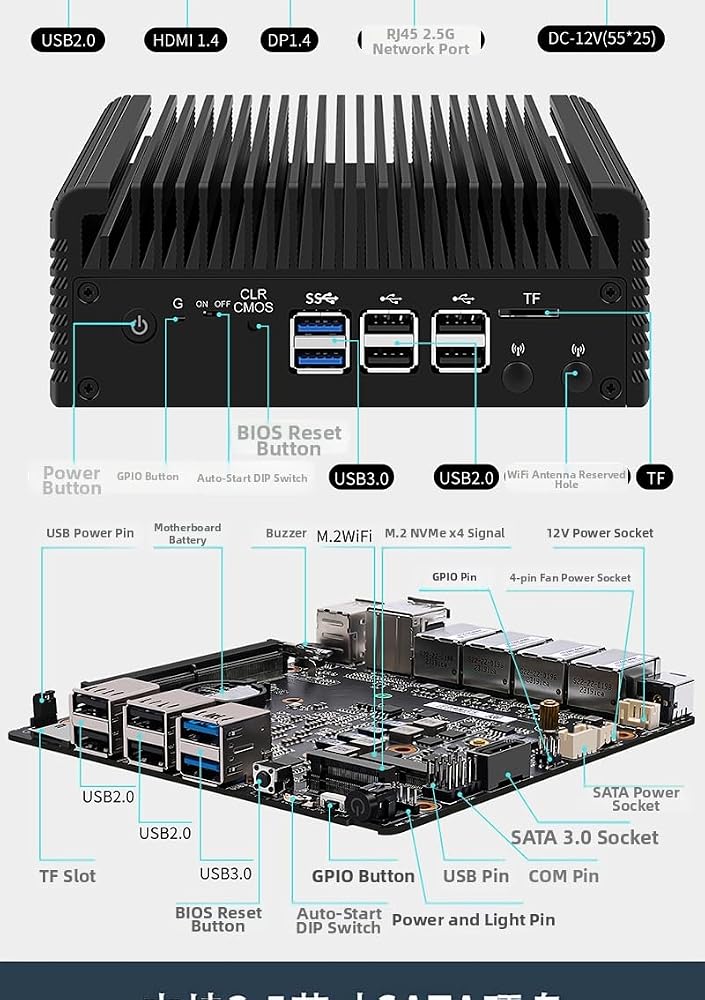
oaknode 4-Port Firewall Appliance
oaknode's fanless barebone adds a SATA port, NVMe x4 + x1, and a DDR5 slot rated to 48GB.
- Silent, fanless design
- 4 LAN ports

The Dozlzyp X4C-XL stretches the usual finned firewall brick to 178mm for more cooling surface, then fills it with four Intel i226-V ports, two NVMe slots and TPM 2.0. Three builds trade USB ports for serial consoles.
The X4C-XL comes in three builds that share the board, the four i226-V ports and the case, and differ only in the rear and front I/O. The base build is USB-heavy. The two others give up USB ports for serial consoles, which is the more interesting trade for a router.
| Build | Video | USB | Serial | Best for |
|---|---|---|---|---|
| Base | HDMI + DP | 8 (2× USB 3.2) | None | Router that may become a small server |
| Updated | HDMI + DP + USB-C | 4 | 1× RJ45 console | Headless router managed like network gear |
| Dual COM | HDMI + DP | 6 | 2× COM | Router plus a serial device, UPS or controller |
An RJ45 console port is the same style of connector enterprise switches and routers use. A standard rollover console cable plugs in, and the router's text console appears on a laptop terminal with no monitor or keyboard involved. When a firewall rule locks you out of the web interface, that port is how you get back in.
The updated build is also the only one with USB-C. Paired with HDMI and DisplayPort, that makes three video-capable outputs, useful if the box ever retires to desk duty.
All three share the same firewall hardware underneath, so routing capability is identical. More on laying out a four-port router lives under N100 firewall mini PCs.
| Spec | Value |
|---|---|
| Model | X4C-XL |
| Processor | Intel N100, 4 cores / 4 threads, 64-bit, up to 3.4GHz |
| TDP | 6W |
| Graphics | Intel UHD Graphics |
| Memory slot | 1× SO-DIMM DDR5 4800MHz, up to 32GB |
| Storage | 2× M.2 2280 NVMe, PCIe 3.0 |
| Wireless slot | 1× M.2 2230 for a Wi-Fi card |
| Ethernet | 4× 2.5GbE, Intel i226-V |
| Video | HDMI 2.0 + DP, dual 4K@60Hz |
| USB | 8 ports (2× USB 3.2); 4 or 6 on the console builds |
| Serial | None, one RJ45 COM, or two COM ports, by build |
| Security | TPM 2.0, AES-NI |
| BIOS features | Watchdog, Auto Power On, RTC wake, PXE boot, Wake-on-LAN |
| Virtualisation | ESXi, Proxmox VE |
| Case | Full aluminium alloy, fanless, lengthened for heat dissipation |
| Dimensions | 178.3 × 135.6 × 55mm |
| Supported systems | pfSense (preloaded OS type), OPNsense, Untangle, OpenWrt |
| In the box | Mini PC, power adapter, cord, M.2 2230-to-2280 adapter board |
| Configuration | Barebone: no RAM, no SSD |
Dozlzyp lengthened the chassis on purpose. At 178.3 × 135.6 × 55mm it is longer and taller than the typical four-port brick, and every extra millimetre is aluminium fin surface. With no fan, surface area is the only cooling there is, so a bigger case is the direct way to run cooler.
The N100's 6W TDP is easy to cool at idle, and routers idle most of the time. The extra surface earns its keep under sustained load, such as Suricata inspecting traffic, a WireGuard tunnel saturating a fast uplink, or a VM running beside the router. The case also works as a quiet 24/7 desktop: add a keyboard, mouse and screen and it becomes a silent workstation.
A cooler chip also holds its burst clock longer before the firmware pulls it back, so the extra fin area is not only about comfort. It keeps throughput steady during long transfers.
Wall power on boxes like this depends on linked ports, the SSDs and memory more than on the chip alone. Hedged idle ranges for four-port firewalls sit under N100 power consumption, and heat behaviour in passive cases is covered under fanless N100 mini PCs.
Storage is two M.2 2280 NVMe slots on PCIe 3.0, no adapters needed. That makes a mirrored ZFS boot pool straightforward, the configuration that keeps a router running when one SSD dies. Memory is one DDR5 SO-DIMM at 4800MHz, up to 32GB.
pfSense, OPNsense and Proxmox all install to a ZFS mirror from their standard installers. Two small, identical NVMe drives are enough; a router writes little, and endurance is rarely the issue. The second slot can hold a larger drive for VM disks instead if you prefer capacity over redundancy.
The box includes an M.2 2230-to-2280 adapter board, which lets a short 2230 SSD sit securely in a full-length 2280 slot. Handy if you have a small drive pulled from a handheld or a laptop.
TPM 2.0 is rare on firewall barebones. It meets the Windows 11 requirement if the box ever becomes a desktop, and on Linux it can hold disk-encryption keys so an encrypted drive unlocks at boot without a typed passphrase. The N100 also carries AES-NI for IPsec and OpenVPN. Deeper chip limits are listed under N100 specs.

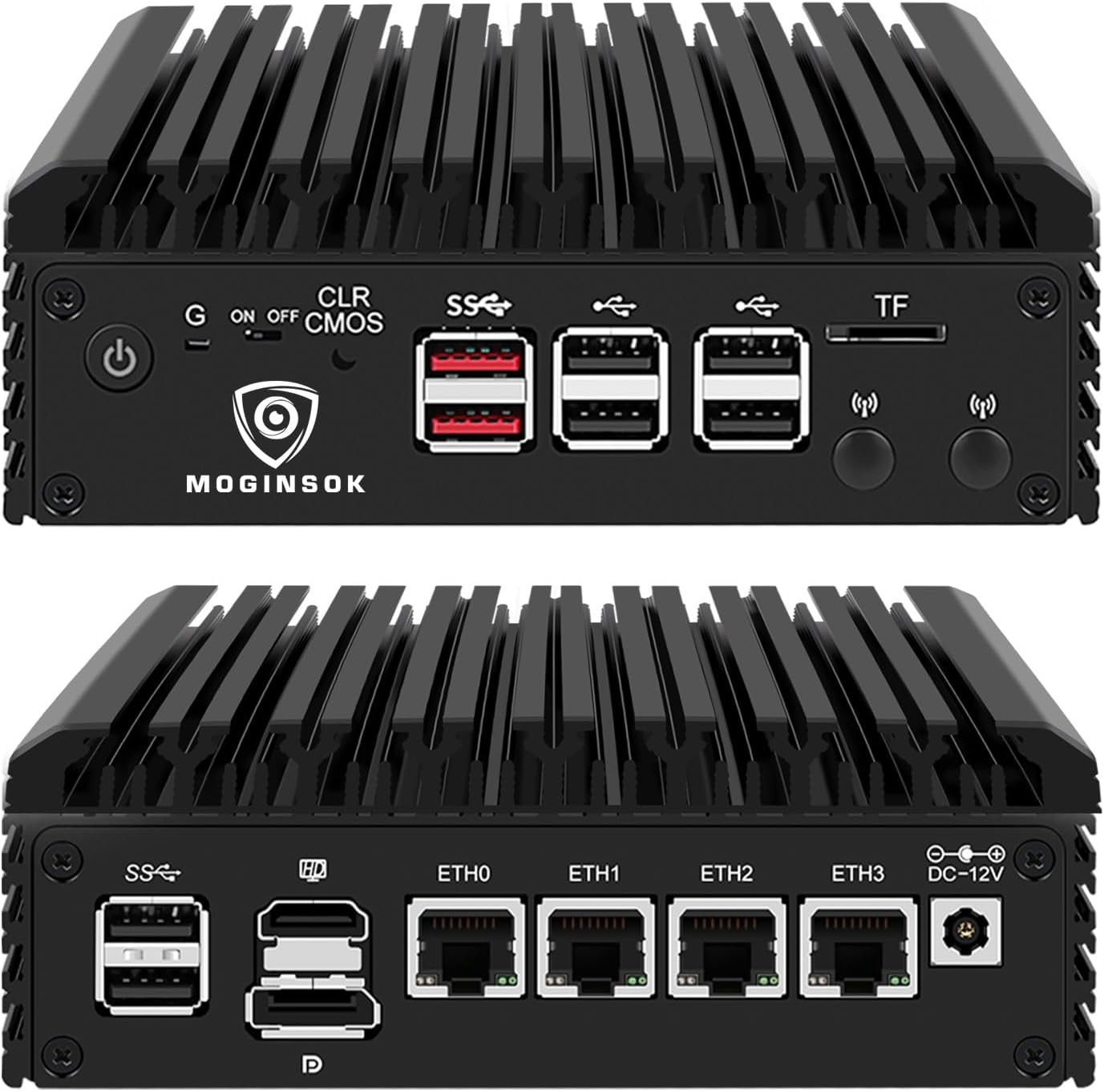
The four i226-V ports are the common denominator of this whole class, and Dozlzyp names pfSense, Untangle and OPNsense as tested systems. The differences are elsewhere: case size, serial options, TPM and how storage is arranged. The X4C-XL wins on cooling surface and console choices.
The oaknode appliance has a SATA port and a 48GB memory rating that Dozlzyp does not, plus an optional fan header. The CWWK box comes configured with DDR5 and NVMe if you would rather not buy parts. The MOGINSOK appliance is also configured and fanless, though current units carry an N150.
The BIOS covers what an always-on router needs: a hardware watchdog to reboot a hung system, Auto Power On after an outage, RTC wake, PXE boot and Wake-on-LAN. ESXi and Proxmox VE are both supported for anyone running the firewall as a VM.
The i226-V runs on FreeBSD's native igc driver, so a current pfSense or OPNsense image finds all four ports at install. If a port ever drops link intermittently, disabling Energy Efficient Ethernet on it is the usual first fix for this chip.
Pick the build by its I/O first. The parts list then stays short: one DDR5 SO-DIMM and one or two M.2 2280 NVMe drives. Check that your shelf or cabinet has room for a 178mm-long box with air above it. For the router-plus-server route, N100 home servers covers the trade-offs.
Only the I/O. The base build has 8 USB ports; the updated build adds USB-C and an RJ45 console with 4 USB; the third has 6 USB and two COM ports.
No. It is a barebone; add one DDR5 SO-DIMM (up to 32GB) and one or two M.2 2280 NVMe drives.
Yes. The full-aluminium case is lengthened to 178.3mm to add cooling surface, and there is no fan.
Yes, TPM 2.0, along with AES-NI, watchdog, Auto Power On and PXE boot.